

What equipment does my child need to practice or play soccer at home
Over the last 20 years or so, the idea of playing soccer at home has changed dramatically. Whereas before it was a case of jumpers for goalposts on a quiet street or in the local park, now there seems to be fewer and fewer places where kids can play the beautiful game.
WMF Coaching Team
4 min read
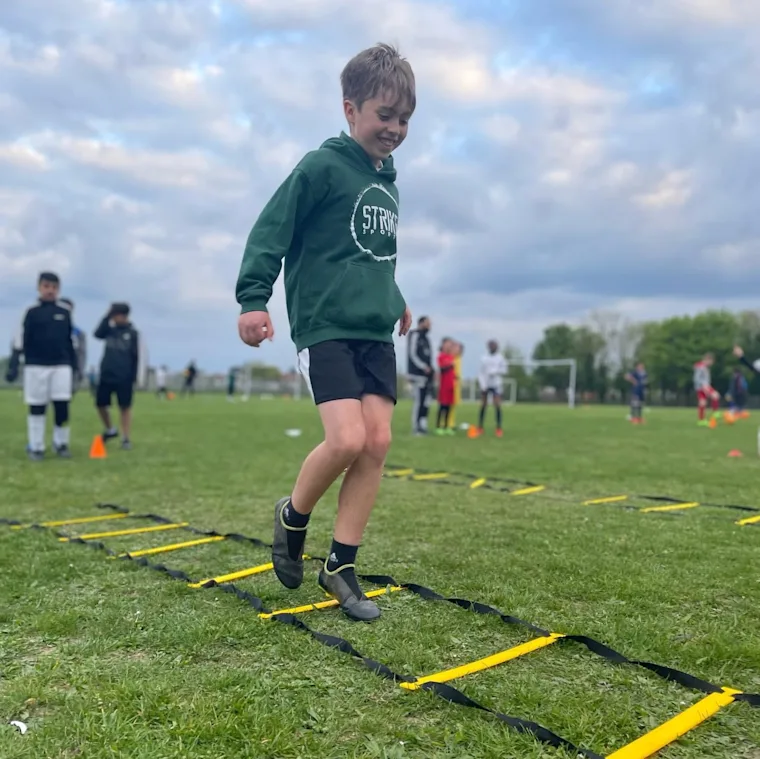
Over the last 20 years or so, the idea of playing soccer at home has changed dramatically. Whereas before it was a case of jumpers for goalposts on a quiet street or in the local park, now there seems to be fewer and fewer places where kids can play the beautiful game.
That is unless you’ve got a garden. Even the smallest of back yards can be turned into a mini Wembley with a little bit of imagination and the right equipment.
Here are some ideas for what you can do and some equipment which can help enhance your child’s soccer practice in the garden all summer long.
A rebounder
No matter how tiny your garden is, you’ll have room for a rebounder as these come in all sizes. This training aid is a small, plastic frame with elasticated netting fitted across it. The player kicks the ball into the rebounder and then has to attempt to control it when it bounces back before passing it back onto the rebounder – and so on.
Because of the elasticated element, the flight of the ball is unpredictable which helps to work on a player’s reaction skills, first touch, improvisation and using both feet. It requires a space no more than a few metres square to work in either.
The rebounder is also a great way for players to practice volleys and half volleys.
One alternative to a rebounder is to use a garden wall. Kicking a ball against a wall is something that countless kids up and down the country have done when growing up and it is an effective method for working on close control.
Futsal ball
Futsal is a small sided version of soccer that was born in Uruguay. It’s played on hard courts similar to a basketball pitch and uses a different type of ball to a traditional soccer.
For starters, a futsal ball is significantly smaller. It’s also heavier, denser and doesn’t bounce as much. As a result, it favours tight control, passing in small spaces and improvisation, speed of movement, all the while demanding excellent technique.
That can make a futsal ball a brilliant piece of equipment, especially in a home environment. It doesn’t travel far and hardly leaves the ground, meaning it’s perfect for using in a confined space.
Most importantly of all though, it will help your child develop the sort of skills associated with all the greatest players from Brazil, Argentina and the rest of South America – which should resonate if you’ve got a mini Messi or Neymar fan.
Samba Goal
Young kids love scoring goals. That’s why the majority of them dream of being a striker. But of course, you can’t score unless you’ve got an actual goal to aim at.
Manufacturers of soccer equipment have realised this which is why lightweight, easy to build goalposts are one of the most popular purchases for the home soccer arena.
Take the Samba Goal for example. So named because it’s the sort of thing that you see put up on Copacabana Beach for a kickaround by some eager Brazilians, it can be erected and dismantled in seconds, is easy to move around and is corrosion proof – not something you need to worry about in Rio De Janeiro too much, but very much a concern with the British weather.
Soccer Tennis
If you’ve got a slightly bigger garden, then you may already have a volleyball or badminton net that comes out during the summer months. The good news is this can also be used for soccer training – or to be more specific, soccer tennis. You could even use a string as the net if you don’t have any of the equipment mentioned.
The idea of the game is to have at least two people either side of the net and they need to control the ball and then return it to the other side. You may need to lower the net depending on the height of the players and their ability. The great thing about this game is that it can be adjusted as the players improve, you could also add conditions to make the game more challenging.
We hope that you have enjoyed this guide on pieces of equipment that can help your child practice in the garden and that this helps your child enjoy their playing soccer in their free time at home. If your child is looking to play soccer with friends during the summer months, then why don’t you give one of our famous soccer holiday camps a try? These are perfect for players of all abilities wanting to enjoy the game and make new friends.
Related Articles

Competitive Soccer Teams and Player Development in Brynmawr | We Make Footballers
Discover the competitive soccer pathway available through We Make Footballers Brynmawr and WMF Gwent, helping young players develop their technical ability, confidence and match experience.
Soccer Classes for 4-Year-Olds in Blackwood | Parent’s Guide
Looking for soccer classes for a 4-year-old in Blackwood? Discover what to expect, whether your child needs experience and how We Make Footballers helps young players get started.
Competitive Soccer Teams and Player Development in Ebbw Vale | We Make Footballers
Discover the competitive soccer pathway available through We Make Footballers Ebbw Vale and WMF Gwent, helping young players improve their technical ability, confidence and competitive match experience.